
Who's Getting the Milk? A Better Way to Shop Together
SharedGrocery is a free shared grocery list that lives inside Telegram. It lets family members, friends and colleagues add items to the same list, divide up the shopping and see changes as they happen. You need a Telegram account, but no separate shopping app or SharedGrocery registration.
If you've ever found yourself at the checkout fifteen minutes before closing time, trying to remember whether someone bought coffee, this story is for you.
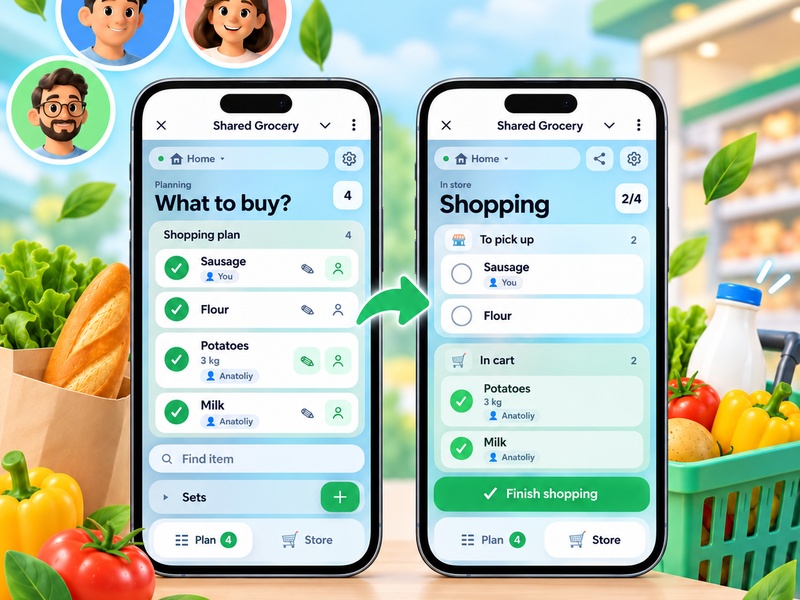
We've figured out how to synchronize databases across continents. Yet somehow, getting milk, bread and coffee for the family can still bring the whole system down.
My wife and I tried the obvious solution: a shopping list in our Telegram chat. It was always there, we could both see it, and messages could be edited. Perfect—until the list disappeared beneath school updates, photos, dinner plans and another 200 messages. Finding the coffee became digital archaeology.
Of course we could install a shopping-list app. There are plenty of good ones. But then everyone has to install it. Everyone has to sign up. Everyone needs to find the right list and remember to open one more app when the coffee runs out.
And eventually somebody writes, “Can you get coffee?” In Telegram. Because that's where the family already talks.
So I asked myself a rather obvious question: why take the grocery list out of Telegram in the first place?
That's how I ended up building SharedGrocery, a Telegram Mini App for shopping together.
A shared list for a completely ordinary grocery run
The first use case is not glamorous. It's Tuesday, the fridge is almost empty, and the shopping plan grows throughout the week.
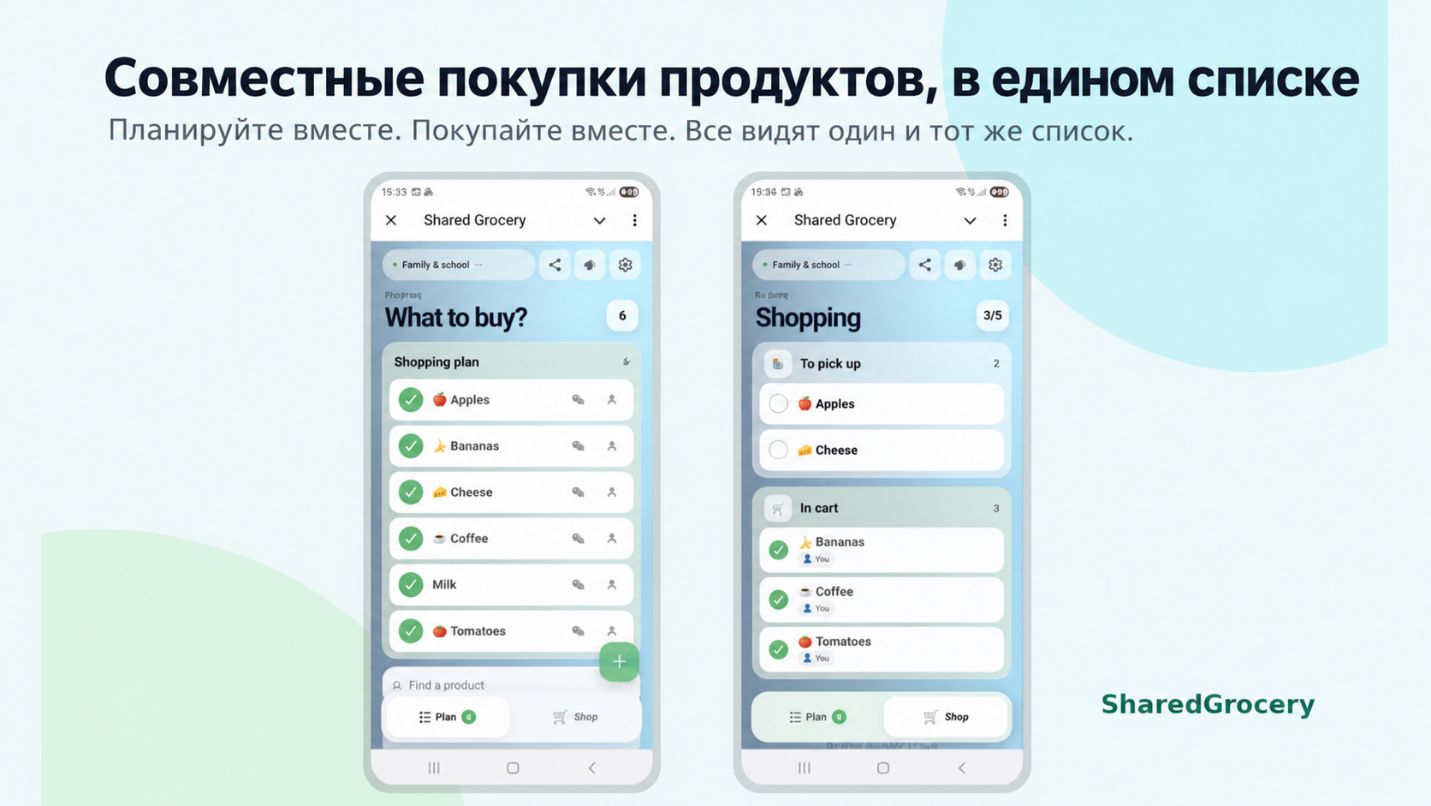
I add tomatoes, bread and coffee. My wife adds the things I would otherwise forget. When one of us heads to the supermarket, we open the same list. We can divide up items and update their shopping status; everyone in the shared space sees the current information when connected.
This is surprisingly liberating. Instead of an urgent family-chat message—“I ALREADY GOT THE TOMATOES!”—you can just get the tomatoes.
And yes, there is voice input. You can say, “Bread, milk, bananas, coffee, cat food,” rather than pecking away at a keyboard in the supermarket.
Voice recognition is not mind-reading. A noisy aisle, fast speech or an obscure brand can still produce an item that needs editing. Sometimes you'll wait a few seconds, too. I would rather tell you that than pretend we've solved speech recognition forever.
How to make a shared grocery list in Telegram
If you arrived here from a search result rather than a family argument about tomatoes, here's the practical version:
- Open @SharedGroceryBot in Telegram and launch SharedGrocery.
- Create a shared space for your family, housemates or group, then add the items you need.
- Send its invitation link to the people shopping with you. They join using Telegram—no separate SharedGrocery account.
- Shop from the shared list, assign items where useful, and update their status as you go.
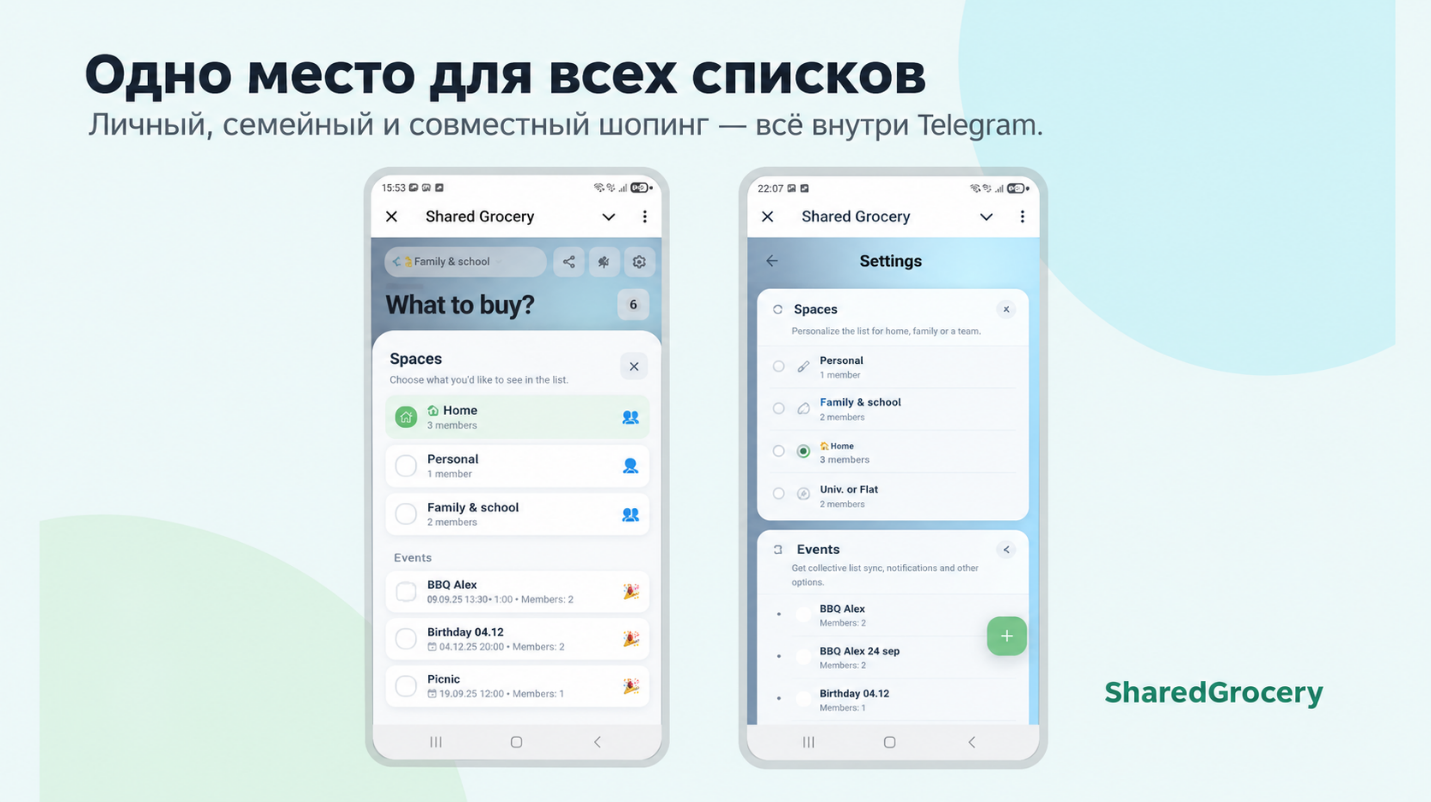
You can keep using the same space for next week's groceries. A one-off event can have its own list, without mixing charcoal and birthday candles into the usual weekly shop.
For a straightforward walkthrough, see the shared grocery list guide.
What if we're shopping for a BBQ, not the fridge?
Let's say ten friends are organizing a BBQ. The group chat usually goes something like this:
“Who's bringing charcoal?”
“Thought you were.”
“I've got the meat.”
“What about vegetables?”
“There are vegetables?”
“And ice?”
“…”
A separate event list is a much calmer arrangement. One person takes the charcoal, another the drinks, another the food. The group can see what's assigned and what's been marked as bought.
That also works for a picnic, a trip or an office supply run. Office supplies can even be a permanent shared space. An office is rather like a family, except the disagreements are about printer paper instead of yogurt.
And if you live with roommates, you probably already know the problem. In a shared apartment, nobody needs to own the seventh bottle of dish soap.
A wedding gift list needs a different kind of sharing
Not every group benefits from complete transparency.
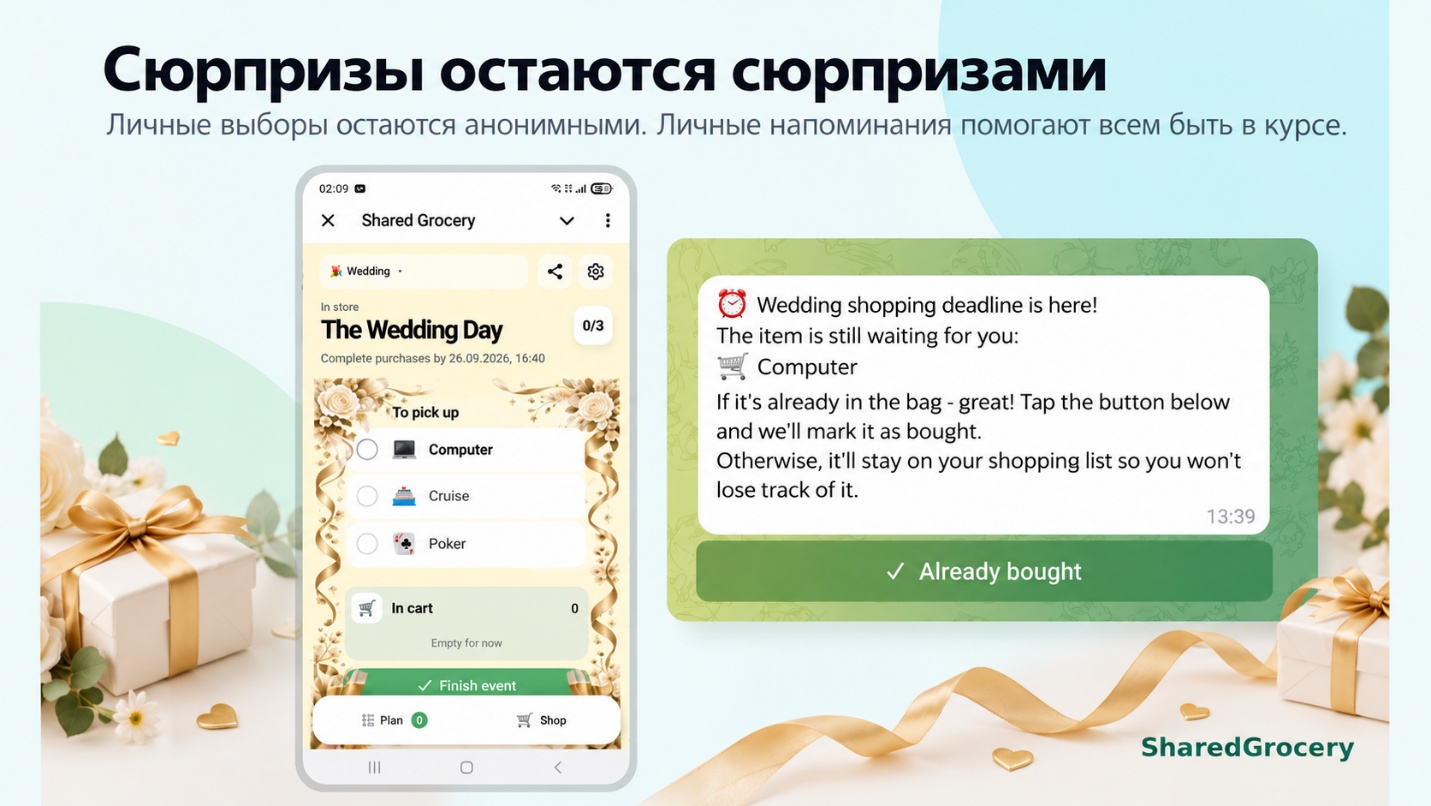
Imagine a wedding gift list. If every guest can see who chose what, the surprise lasts about seven seconds: the Smiths are buying the coffee machine, the Joneses have the vacuum cleaner, and someone has already claimed the mysterious envelope.
For this, SharedGrocery has a special event with private choices. The organizer manages the list. A participant sees the available items and their own choices, not other people's selections. The organizer can see the items, without being shown which participant chose each one.
Guests can coordinate gifts without turning the wedding into a public procurement report. The same idea works for an anniversary or a birthday surprise.
The privacy rules here are intentionally different from an ordinary family shopping space. In a standard shared list, assignments are visible to the group; a private-choice event is designed to hide other people's choices.
The shopping list can wear a party outfit
Technically, a weekly grocery list, a wedding wishlist and a wildly enthusiastic bachelor party share the same basic ingredients: list things, divide them up, get them, and try not to forget anything.
But they hardly feel like the same occasion.
So we added decorative event frames and themes. A wedding can have flowers; a Halloween gathering can have pumpkins; a holiday party can look like a holiday party. There's room for more personal styling, too.
Reminders for the person who thought the picnic was tomorrow
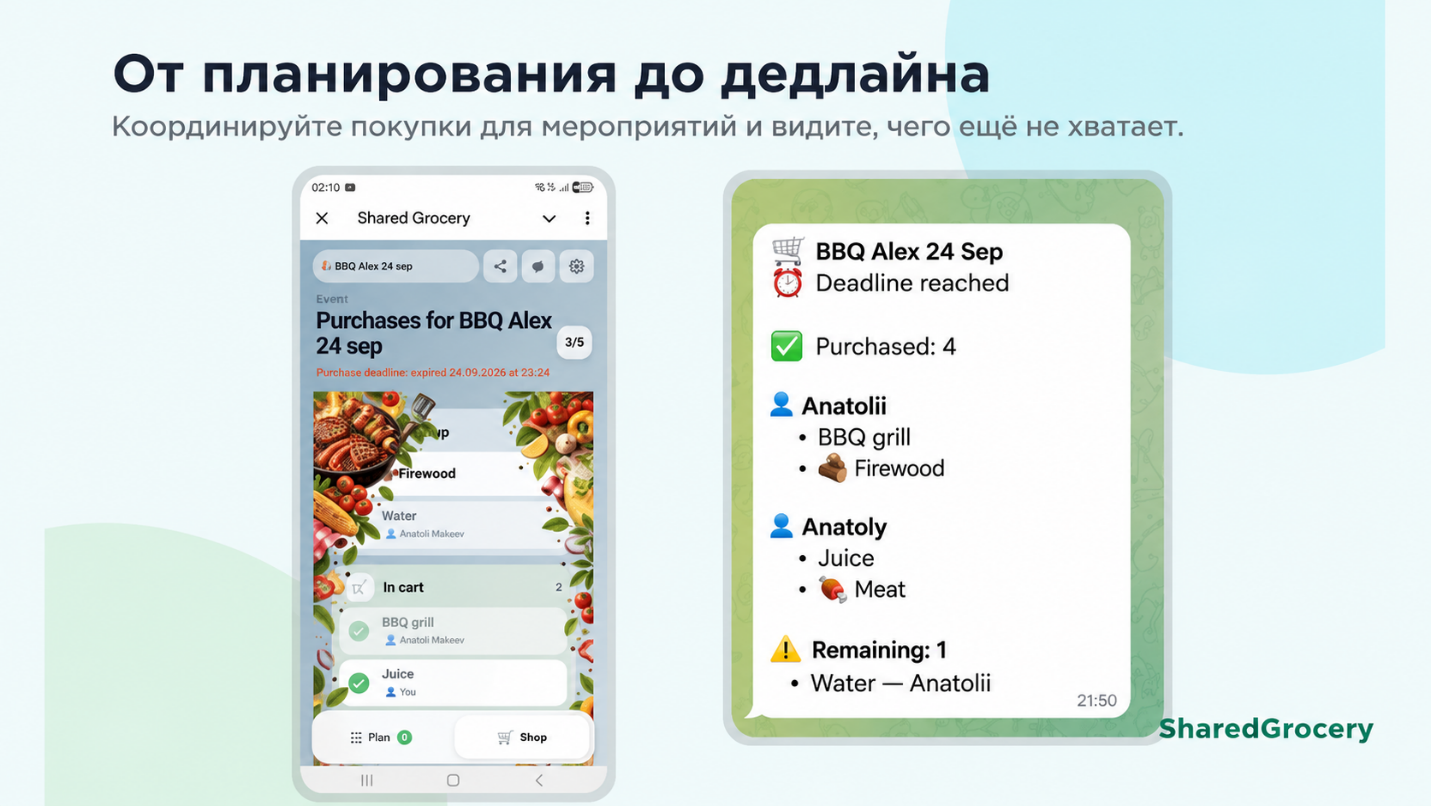
An event can have a shopping deadline. For regular events, a group summary can help people see what's already bought and what's still missing.
For private-choice events, the reminder goes to the relevant person in Telegram rather than revealing their choice in a group message. That matters when the item is meant to be a surprise.
Useful? Absolutely. Especially when the person responsible for charcoal discovers, two hours before the picnic, that the picnic is not tomorrow.
What's the catch?
SharedGrocery is not trying to become a complete household management platform. It is not an expense tracker, a grocery spending dashboard or a shared calendar for dental appointments. There is no sophisticated report called “Yogurt Consumption: Budget vs. Actual, Q3.”
It's a shopping list. A shared one.
It also needs an internet connection to keep everyone in sync; there is no offline shopping mode to rely on. Voice input can get things wrong, and a young independent product will inevitably have some rough edges.
One advantage of a small project is that a message saying “this is awkward” has a non-zero chance of reaching the very person who made it awkward. Feedback through the bot is welcome.
Why is it free?
There's no grand philanthropic backstory.
I'm trying to find SharedGrocery's first real users, and the advertising budget is zero. Literally zero. So the idea is to make it easy to try:
See it → open Telegram → use it on a real shopping trip.
No credit card, paid trial or obligatory “Pro” upgrade just to buy milk. At the moment, SharedGrocery is free to use.
And shared lists have one interesting property from a tiny project's point of view: one person rarely uses one alone. A family list reaches a partner; a BBQ list reaches friends; an office list reaches colleagues.
So the business plan, if we're being generous with the term, is:
Make something useful → give it away → hope people invite the next person.
Will it work? I'm finding out. I'd rather have real groups completing their shopping than spend this month designing Free, Pro, Premium and Mother-in-Law Enterprise pricing tiers.
Try one real shopping trip
If you, your family, your roommates or your friends already use Telegram, don't create a pretend list just to admire the buttons.
Use SharedGrocery for the next actual grocery run, picnic, party or office purchase. Add the things you really need, invite the real people, and see whether you get through the shopping with fewer panicked messages.
The worst that happens? You go back to a group chat full of “WHO GOT THE MILK?”
The best? You stop needing to ask.
P.S. SharedGrocery still cannot decide who actually has to run to the shop. That one is up to the humans. Rock, paper, scissors remains a perfectly serviceable protocol.